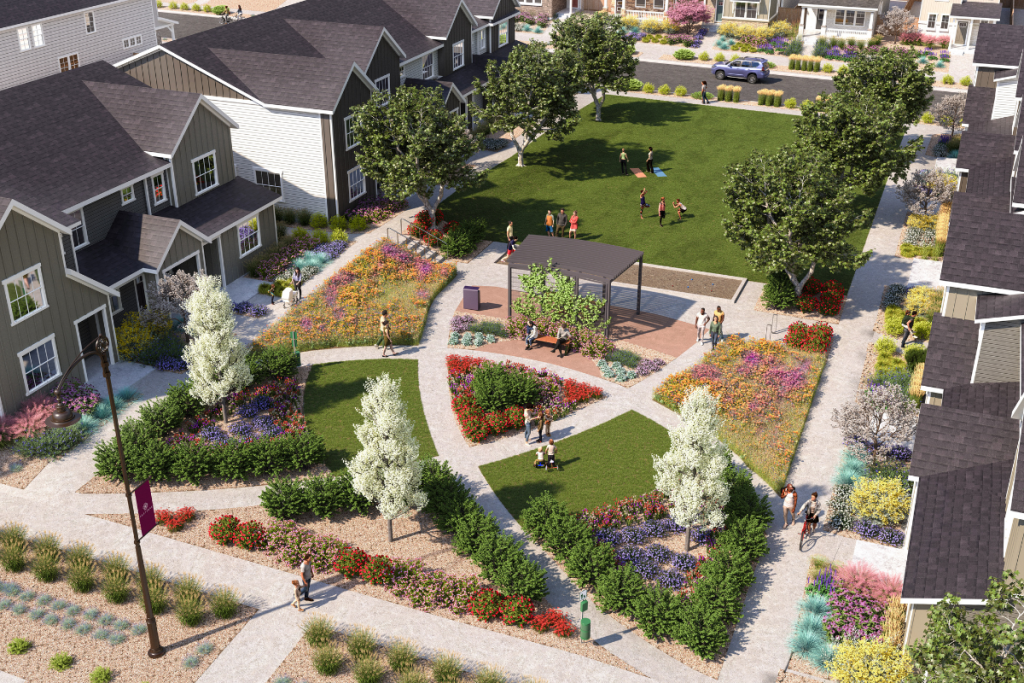
Colorado master-planned communities are large-scale residential developments designed before construction begins, where parks, trails, amenities, and neighborhood layouts are coordinated from the start rather than filled in over time. For buyers considering a move in the Denver metro or along the northern Front Range, several active communities are taking shape right now, each with a distinct location, builder mix, and lifestyle emphasis.
This guide covers what separates a master-planned community from a standard subdivision, where active communities are located across Colorado, and what to evaluate when you are comparing your options.
What is a master-planned community?
A master-planned community is a large residential development built according to a unified design that integrates housing, green space, and amenities before the first home is sold.
The difference from a standard subdivision is meaningful. In a typical subdivision, builders purchase lots and develop them independently. Parks, retail, and shared spaces are often added years after residents move in, if they arrive at all. In a master-planned community, those elements are coordinated upfront. Trails connect to parks. Parks connect to neighborhoods. Streets and pathways are laid out to encourage foot traffic rather than discourage it.
This coordinated planning creates a more consistent physical environment from day one. Research tracking master-planned community performance nationally has consistently found that coordinated amenity delivery is associated with stronger long-term resale performance compared to subdivisions where infrastructure is developed piecemeal.
Where are Colorado’s active master-planned communities located?
Active Colorado master-planned communities are concentrated in the Denver metro area, with additional development in northern Colorado near Windsor and Fort Collins.
Among Denver metro options, master-planned communities in Thornton, Colorado have drawn significant buyer attention in recent years. Thornton sits at the intersection of I-25 and E-470 in the northeast metro, offering competitive land prices, newer infrastructure, and straightforward highway access to both downtown Denver and Denver International Airport. For buyers who commute in more than one direction, or who value airport proximity, it is one of the more practical addresses in the metro.
The south metro corridor (Littleton, Douglas County) tends to carry higher land prices but places buyers closer to Denver’s tech employment centers along I-25. Northern Colorado communities near Windsor attract buyers who prioritize open space and proximity to Fort Collins over daily metro access. Each corridor rewards a different set of priorities, and the right location depends on where your week actually takes you.
What should you look for when comparing master-planned communities?
When comparing Colorado master-planned communities, evaluate five things: location and commute access, amenity delivery timeline, builder quality and selection, HOA structure, and where the community is in its development phases.
Location and commute access. The address should work for your actual routine, not a best-case scenario. Check commute times during peak hours. For buyers working in Denver, Boulder, or the Denver Tech Center, the drive at 8 AM on a Tuesday is the number that matters, not the posted distance.
Amenity delivery timeline. Some communities promise trails and recreation centers that are years from being built. Ask which amenities are open today, which are under construction, and which are planned for future phases. A trail system that exists now and one slated for Phase 3 are not the same thing.
Builder quality and selection. Master-planned communities typically feature one or more homebuilders. Look at each builder’s track record in Colorado, their floor plan range, and their warranty programs. Multiple builders in one community generally means more options across price points and home styles. Model home visits are the most efficient way to evaluate finish quality and floor plan practicality side by side.
HOA structure. Master-planned communities include homeowners associations that maintain shared spaces, enforce design standards, and often fund community programming and events. Review the monthly fee, what it covers, and how reserves are funded. If you want more detail on how HOAs function inside planned communities, the decision guide on whether a master-planned community is right for you covers the tradeoffs directly.
Phase maturity. Buying early in a community typically means lower prices and more home selection but also more active construction nearby. Buying in a later phase means a more finished environment but a narrower range of available homes. Neither is the better answer in general. The right timing depends on your schedule and your tolerance for a neighborhood still taking shape around you.
How does Parterre fit into Colorado’s master-planned community landscape?
Parterre is an 800-acre master-planned community in Thornton, Colorado, developed by Hines, with homes built by Lennar and Taylor Morrison. At full buildout, the community will include nearly 3,000 homes across five distinct neighborhoods.
Parterre’s location at Quebec Street and E-470 in northern Thornton places it within 20 minutes of downtown Denver, 25 minutes of Boulder, and roughly 20 minutes from Denver International Airport via E-470. That positions it in a useful middle zone for buyers who commute in more than one direction or value airport access alongside city proximity.
The Garden North neighborhood is Parterre’s first village and where homes are available now. The neighborhood includes 22 parks, a central green, pickleball courts, a community garden, and the Wildflower Walk trail system, which winds through native Colorado landscape connecting the neighborhood’s streets and green spaces. The Todd Creek Greenway runs through the site, extending residents’ access to open space beyond what the neighborhood itself provides. For a closer look at how those amenities function day to day, this walkthrough of a day in Garden North covers the detail. A recreation center with a pool is planned as the community grows.
Lennar and Taylor Morrison each bring distinct collections to Garden North. Lennar’s Horizon series spans roughly 1,600 to 2,900 square feet across several floor plans. Taylor Morrison’s City, Landmark, and Destination collections are available now, with additional collections launching in spring 2026. A full breakdown of available home styles at Parterre covers floor plan ranges, home types, and what each builder offers across price points.
For a closer look at how Parterre stacks up against other new communities in Thornton, this comparison of Parterre and other Thornton communities walks through the key differences in design approach, amenity depth, and builder options.
How do you move from research to a decision?
Most buyers researching Colorado master-planned communities are working through three questions at once: whether the community format suits their lifestyle, whether the location makes practical sense, and whether the timing is right for them personally.
The first two are answerable with research and a site visit. The third depends on circumstances specific to each buyer. What a visit can resolve is the gap between what a community looks like on paper and what it actually feels like to walk its trails, stand in a model home, and drive the route to work at the hour that matters.
If you are still working through the format question, the decision guide on master-planned community living covers the core tradeoffs in practical terms. If you are further along and want to see Parterre specifically, the Parterre community page has current information on available neighborhoods, builders, and homes.